By Ed Rampell
“In one hour and 39 minutes, Rick Goldsmith admirably covers the proverbial waterfront in his well-made, thought-provoking chronicle about the fall of print journalism – and its possible rise again. Stripped is essential reading – or rather viewing – for anyone concerned with the issue of freedom of the press in the period of late-stage capitalism.”
The Commodification of Newspapers
In the Bill of Rights, there is only one private industry singled out for protection by the federal government: The press. Yet, despite being enshrined in the First Amendment and being “a vibrant part of American life since the beginning of the republic,” in the 21st century “2,000 newspapers have disappeared, along with 60% of working journalists,” according to narrator Rick Goldsmith, who also directed Stripped for Parts: American Journalism on the Brink. While newsrooms in major urban centers such as Los Angeles have suffered, local and rural communities have been especially hard hit by this deep decline, producing what the documentary calls “news oases” across the land.
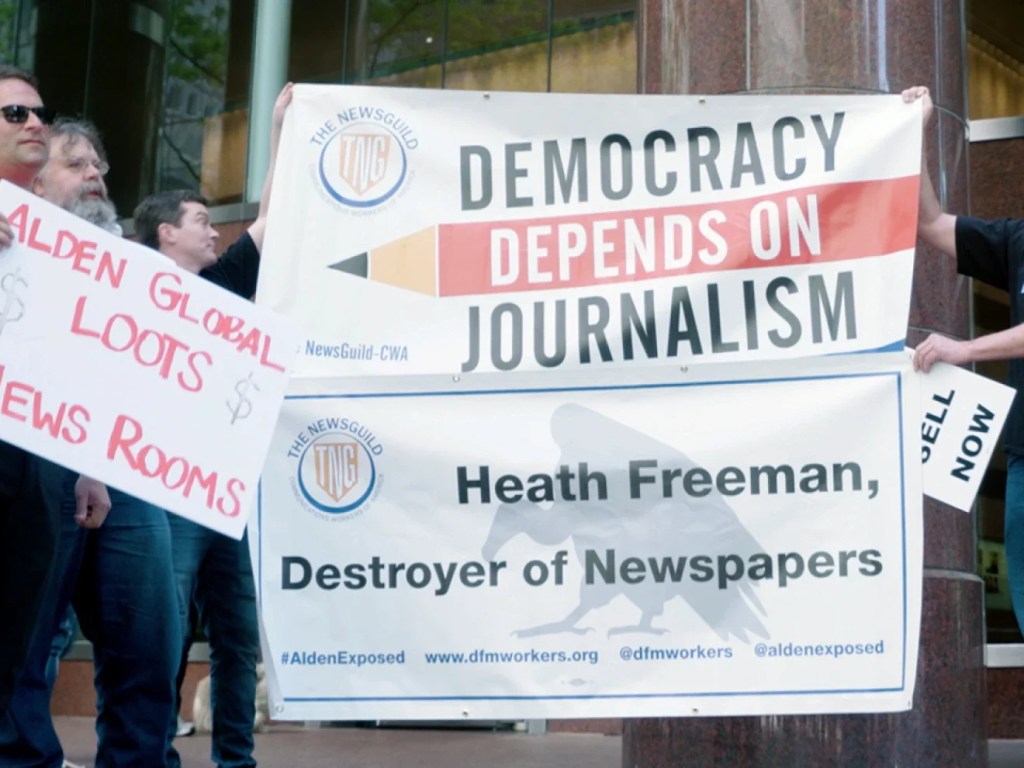
In his new documentary, the two-time Oscar nominee is hot on the trail of the culprits that have caused the downfall of much of the press. While the new business model and technology of the Internet are usually blamed for the demise of dailies and other print publications, Goldsmith, the journalistic gumshoe, unearths another villain: Vulture Capitalists. Stripped names names and zooms in on Alden Golden Capital – which owns Digital First Media, one of America’s largest newspaper chains – and its head honchos, the secretive Randall Smith and Heath Freeman. The house specialty of this privately held investment manager and hedge fund is “distressed asset investing,” and the film contends Alden seeks out troubled businesses and then plunders them, then stashes their loot in tax havens at Jersey and the Cayman Islands.
Prime targets are newspapers rendered vulnerable by the Internet, which disrupted the longtime fiscal foundation of dailies and weeklies. In one of Stripped’s so-called “History Lessons,” the film flashes back to 1835, when revenue for advertisements surpassed that for selling the papers themselves for the penny press, such as the New York Herald, published by James Gordon Bennett Sr. Goldsmith comments onscreen that “The union of capitalism and journalism is a marriage made in heaven.”
This business model served as the economic basis for the newspaper industry until classified ads were wooed away by Craigslist and other online entities, that allowed advertisers to post classified ads more inexpensively and directly on the Internet, which, as it gained in popularity, accessibility and with increasing technical capacity, enabled masses to read help wanted, rental, dating and other advertising on their computers then phones, without having to purchase publications.
Newspapers may have suffered from the steep decline in their advertising base, but legacy media outfits often had valuable assets inherited from their glory days. In particular, the buildings of many newsrooms and printing presses were prime real estate, and as we all know, “Location! Location! Location!” is the name of the game in that competitive business. For instance, the Denver Post was centrally located in a hot property at a historic Civic Center which includes the Colorado State Capitol Building and other government edifices, the Denver Art Museum, Denver Central Library, etc.
As media mogul Dean Singleton’s news empire faltered and faced bankruptcy, the Vulture Capitalists swooped down on the Denver Post in 2010 as part of the takeover of MediaNews Group’s chain of 56 dailies. Alden proceeded to enforce a ruthless profit extraction scheme, implementing extreme cost-cutting, including drastically downsizing the Post’s staff. It leased out and eventually sold the valuable Post building and “in 2017, shortly before laying off a third of the Denver Post newsroom, the cost-cutting hedge fund that owns the paper marched its remaining journalists out of the downtown Denver building and into a printing plant in a polluted industrial zone in Adams County,” according to https://coloradomedia.substack.com/p/who-is-buying-the-iconic-denver-post. From being located right at the prestigious hub of Colorado’s culture and power, the remaining scribes were banished to the hinterlands, miles outside of Denver.
(NOTE: While Stripped highlights the Denver Post, it does also consider the trials and tribulations of Chicago Tribune, Baltimore Sun and other newspapers.)
A “Social Good” Vs. “Greed is Good”
Many of the numerous journalists interviewed onscreen stress the historic, essential role the press has played in American democracy. NewsGuild President Bernie Lunzer sums up the essence of their argument, insisting “Journalism is a social good.” Politician and businessman Stewart Bainum adds: “No other industry is so vital to our democracy.” In a clip from his HBO program Last Week Tonight with John Oliver, the eponymous Emmy-winning host argues: “Media is a food chain that falls apart without local newspapers.”
On the other hand, the take-the-money-and-run ethos of Alden and other newspaper profiteers is excoriated in the documentary. Former Denver Post editor Greg Moore laments that his new bosses “didn’t know anything about newspapers” and insists that when it comes to journalism, “you can’t just leave it up to the market.” Goldsmith cinematically makes his point by cutting to a clip of Michael Douglas as the ruthless Gordon Gekko in Oliver Stone’s 1987 Wall Street proclaiming: “Greed is good.” At another point in Stripped, as the Vulture Capitalists are critiqued, the film is intercut with footage of actual vultures picking at carrion.
Stripped is full of these filmic flourishes that enlivens the storytelling laden with talking heads from the news biz. There are scenes from other classic movies, such as Robert Redford as Bob Woodward in the 1976 Watergate drama All the President’s Men; Rosalind Russell in Howard Hawks’ 1940 screwball comedy His Girl Friday; Orson Welles’ 1941 masterpiece Citizen Kane; Kirk Douglas in Billy Wilder’s 1951 Ace in the Hole; and a clip from one of the many pictures wherein Spencer Tracy played a newspaperman. Goldsmith also deploys presumably original cartoon images.
A gifted filmmaker, the two films Goldsmith has received Best Documentary Academy Award nominations for have both dealt with the topic of journalism. 1996’s Tell the Truth and Run: George Seldes and the American Press is a biopic narrated by Susan Sarandon, with Ed Asner reading texts, about the muckraker who interviewed V.I. Lenin in 1922 in Moscow and was expelled from fascist Italy by Mussolini. 2010’s The Most Dangerous Man in America: Daniel Ellsberg and the Pentagon Papers is a biopic about the whistleblower and one of the highpoints of American journalism, which won a prestigious Peabody Award.
Journalism’s Paths Less Traveled
Goldsmith invests his artistry and passion for the free press into his saga about the distressed asset investing he believes is wreaking havoc on American journalism. In addition to lampooning the Vulture Capitalists and how they hawk their wares, as if news is a mere commodity to be bought and sold, Stripped also explores alternative models of reportage. Of course, the workers who are being downsized and strip-mined by this voracious, rapacious process are – unlike most employees in other industries – professional, skilled mass communicators. And these ink-stained wretches, who share Goldsmith’s ardor for journalism and outrage at its despoilation, aren’t just lying down and taking it.
Moving on from their former, now downsized reportorial outlets, some newsmen/women seek alternative economic models within which to ply their trade. Some question the capitalist modus operandi – veteran journalist Julie Reynolds, an original investigator of Alden Global Capital, asks: “Why expect journalism to make a profit? …The capitalist model is not appropriate for this service.” Comparing newspapers to fire departments, Stripped makes the point that while both are socially necessary, but nobody expects fire stations to be profitable ventures.
However, it must be said that capitalist cannibalization all seems perfectly legal under America’s prevailing free enterprise system. While the First Amendment stipulates “Congress shall make no law… abridging the freedom of speech, or of the press,” the Constitution says nothing about Vulture Capitalists snuffing out this bulwark of freedom of speech that is an essential ingredient of democracy in the public square and marketplace of ideas. As Thomas Jefferson argued in 1786: “Our liberty depends on the freedom of the press, and that cannot be limited without being lost.”
Dave Krieger, former Boulder Daily Camera editorial page editor, pointedly asks: “Who owns the news? Does the First Amendment suggest we the people own the news?” Of course, this leads back to A. J. Liebling’s oft-repeated famous quote: “Freedom of the press is guaranteed only to those who own one,” and many of Stripped’s discarded, disenchanted newshounds seek to do just that, to set up their own independent means of expression. A number of them are nonprofit, locally-oriented and online.
Of course, these digital and print platforms require funding, and in some high profile cases, billionaires have stepped into the void. They include: Amazon tycoon Jeff Bezos’ legacy media Washington Post purchase; eBay founder Pierre Omidyar’s launching of Honolulu Civil Beat and The Intercept; and on the social media front, Elon Musk’s acquisition of Twitter (now X). (Stripped doesn’t per se cover these capitalists and their adventures in journalism, and it’s beyond the scope of this story to do so here.)
Goldsmith’s film briefly mentions the notion of some sort of public funding to support news reporting. Greg Moore advocates “Tax support for public journalism” – which is in the tradition of the federal postal subsidies provided publications starting with President George Washington’s administration, when much of the news was delivered via the U.S. mail. The work of John Nichols and Robert McChesney’s Free Press, which has been called “the nation’s media-reform network,” is also cited. As is Michigan’s Flint Beat, whose parent company, Brown Impact Media Group, “is focused on developing news products in underserved and marginalized communities starting with Flint” (see: https://flintbeat.com/).
The Readers’ Role?
But what is the crucial role of the readers, the consumers that the news “product” is supposed to be for? It is often said that Americans don’t read anymore. But I’m not sure that’s true – people may no longer subscribe to or buy from newsstands, etc., print publications in the numbers that they once did, but they certainly do read, albeit in different nontraditional formats and modes. On their phones, on computers, and other devices. The World Wide Web has opened up new realms for and means of reading. Bloggers, substackers, etc., have put Liebling’s free press into the hands now of ordinary people who weren’t guaranteed that right of owning a press mainly by virtue of their pocketbook.
Having said that, given the amount of disinformation and distraction people are incessantly subjected to with endless bread and circuses, it doesn’t mean that when they online they’re reading anything worthwhile. Most Americans are overworked and hard-pressed to survive, with little leisure time, easily distracted and inundated by endless propaganda and advertising. In their spare time, when Americans log on, are they doing so to read CounterPunch – or, in seeking respite from their daily pressures via mindless escapism, perusing the latest Internet meme, TikTok dance or cat videos?
Onscreen Steven Waldman wisely points out: “We’re not going to save community journalism without communities themselves taking action.” Stripped alludes to but doesn’t dwell on the role audiences must play in elevating and demanding something worthwhile to read, and financially supporting it. Nor does Stripped critique the pre-Internet paradigm of how an overreliance on advertising often limited what newspapers could and could not cover fairly.
The documentary also overlooks the treacherous role played by much of the MSM in the period of the Iraq War, when newspapers such as The New York Times and many other outlets spread baseless lies about Saddam’s nonexistent weapons of mass destruction, et al, acting as propagandistic mouthpieces for the Bush regime. This widespread, shameful betrayal of the role of a free press that reports without fear or favor and speaks truth to power arguably turned millions away from newspapers being a trusted source of information. Trump capitalizes on this undermining of the public’s trust when he lambastes the press as “fake news” and “the enemy of the people.” If he gets reelected, between Trump and Vulture Capitalists, how will the Fourth Estate survive?
Nevertheless, in one hour and 39 minutes, Rick Goldsmith admirably covers the proverbial waterfront in his well-made, thought-provoking chronicle about the fall of print journalism – and its possible rise again. Stripped is essential reading – or rather viewing – for anyone concerned with the issue of freedom of the press in the period of late-stage capitalism.
Stripped for Parts: American Journalism on the Brink opened October 4 in Los Angeles at the Laemmle Royal and then followed by a national rollout in select cities. For details see: https://strippedforpartsfilm.com/screenings/.
Ed Rampell was named after legendary CBS broadcaster Edward R. Murrow because of his TV exposes of Senator Joe McCarthy. Rampell majored in Cinema at Manhattan’s Hunter College and is an L.A.-based film historian/critic who co-organized the 2017 70th anniversary Blacklist remembrance at the Writers Guild theater in Beverly Hills and was a moderator at 2019’s “Blacklist Exiles in Mexico” filmfest and conference at the San Francisco Art Institute. Rampell co-presented “The Hollywood Ten at 75” film series at the Academy Museum of Motion Pictures and is the author of Progressive Hollywood, A People’s Film History of the United States and co-author of The Hawaii Movie and Television Book.
 STRIPPED FOR PARTS